The journalist as a social mediator, a creator of dialogue, and a broker of social consensus.
Social and political polarization is now nearly ubiquitous throughout the Western world, describing a process that leads to the emergence of two extreme, opposing camps—an “us versus them” dynamic.
The polarization of society is multidimensional. Traditional demographic indicators—such as age, place of residence, and education—no longer solely determine people’s attitudes. Divisions now encompass identity, worldview, culture, social norms, political beliefs, religion, and more.
The media’s presence and role are not inconsequential to this polarization, as they do not merely report on reality—they actively help shape it. The language journalists use to present events and frame their context can either facilitate or hinder the development of a social compromise. Biased framing of events, the emotionalization and radicalization of language, the existence of information bubbles and echo chambers, political pressure, market pressures and an excessive focus on negative messaging all pose significant obstacles to the media’s fundamental social and political functions.
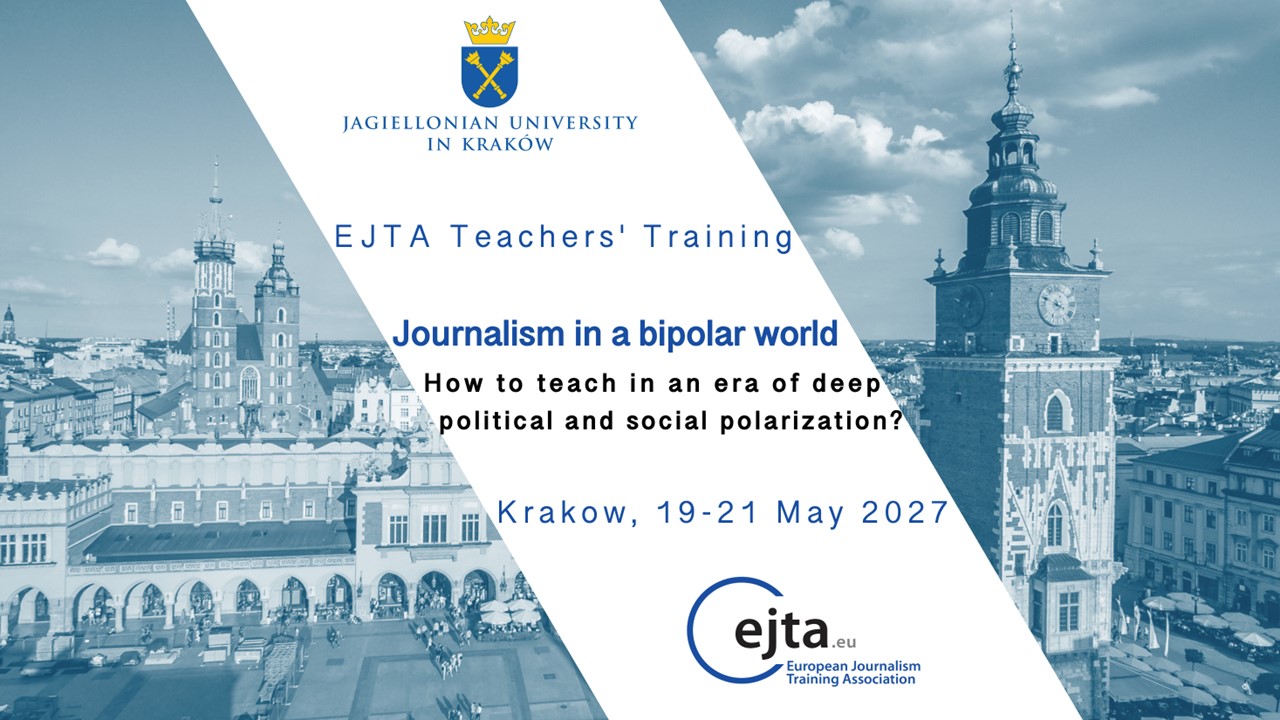
The discussions about this topic serve as the starting point for the EJTA Teachers’ Training, ‘Journalism in a bipolar world: how to teach in the era of deep political and social polarization?’ which will take place from 19–21 May 2027, in Kraków, Poland.
Further information and registration will be available later on the website for the EJTA training in Kraków (2027).
Can’t wait to see you in Krakow!
More information:
Agnieszka Szymańska agnieszka.szymanska@uj.edu.pl /
Nadia Vissers director@ejta.eu /
Henna Turunen info@ejta.eu